For restaurants
The comment card, rebuilt for how guests actually behave
Paper comment cards had the right idea: hear it from the guest, privately, before the internet does. Here is how the card compares with what replaced it, which questions are worth asking, and how Bentu keeps the idea and fixes the rest.
Free to start, and no credit card for the 30-day trial. We check every claim by hand, usually within 2–3 business days.
Why did paper comment cards stop working?
Few guests carry a pen. The card competes with the check for attention at the worst possible moment. The ones that do get filled out are often illegible, blank except for a smiley face, or from the same regular every week. And once a card lands in the shoebox in the office, its story ends — no reply to the guest, no follow-up, no way to know if the fryer complaint from March ever got fixed.
Meanwhile the guests with real opinions skip the card entirely and post them on Google, where a bad night follows you around.
Comment card questions worth asking
Whatever you use, a short card gets finished and a long one gets abandoned. Pick three to five of these, put the rating first and the open question last:
- How was your visit today? Offer three choices, such as Not good, Good or Great.
- Would you come back?
- What was the best thing you had?
- Was anything not right? What happened?
- Did anything take longer than you expected?
- Is there anyone on our team you’d like to mention?
- What’s one thing we could do better?
- Is this your first visit?
- How did you hear about us?
- May we contact you about your visit? Leave an email or phone number if so.
Questions to leave off
Skip anything you won’t act on. A grid that asks for a score from 1 to 10 on food, service, cleanliness, value and atmosphere is tiring to fill in on paper and worse on a phone, and a column of numbers rarely says what actually happened. One open question does that better: the guest tells you which part of the night it was about, in their own words.
Leave out anything that sounds like a test of the staff member standing nearby, and never ask for a review in exchange for a discount: keep the card about the guest’s visit.
The digital comment card, done properly
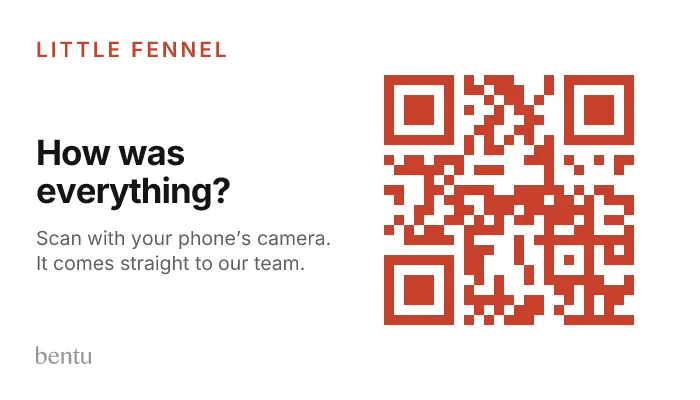
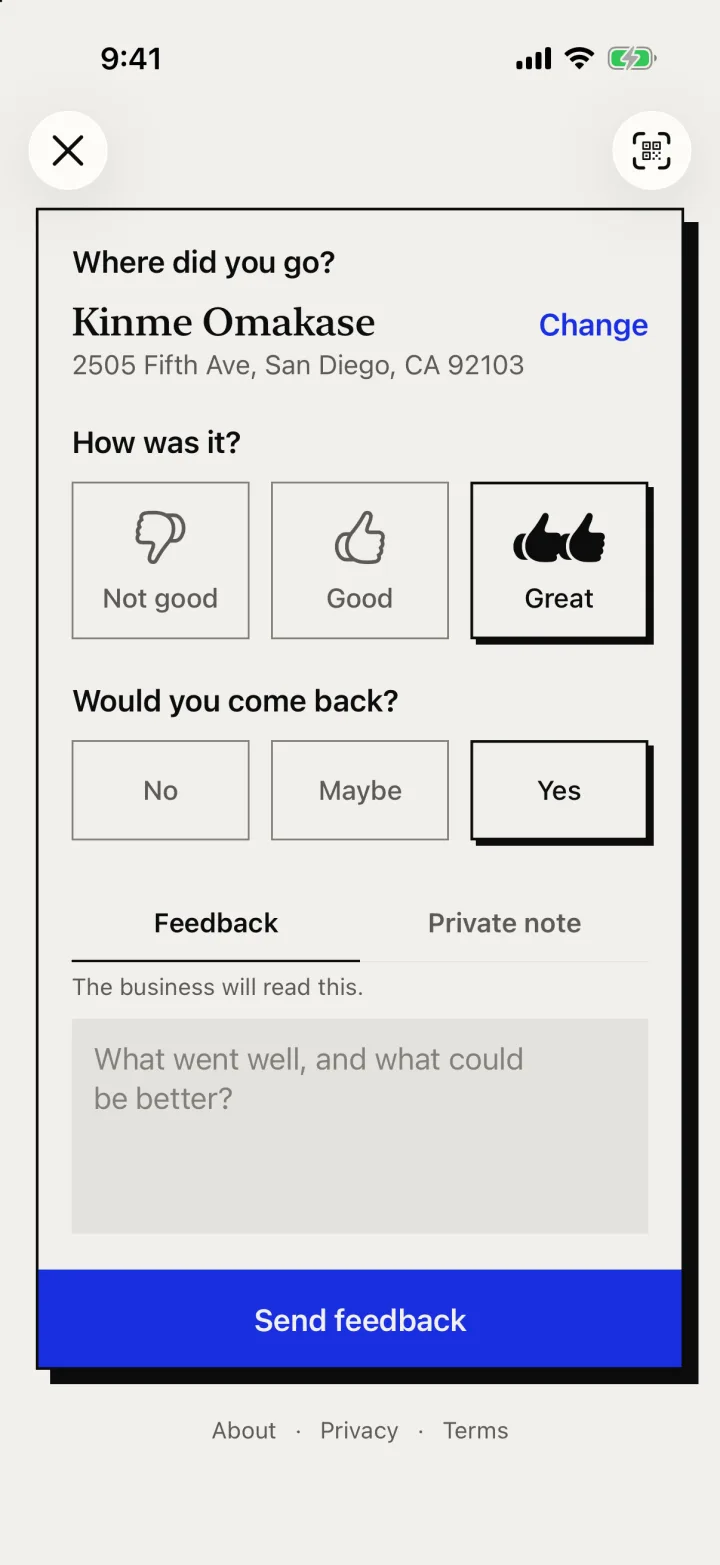
Bentu replaces the card with a QR code on the table, the counter, the check presenter or the to-go bag. Guests scan it and answer the questions that matter most, the same ones every time: How was it? (Not good, Good or Great), Would you come back? (No, Maybe or Yes), and a few words if they like. It takes seconds and works on any phone with no app download.
Everything a paper card couldn’t do comes with it:
- Feedback lands in your dashboard the moment it’s sent — sometimes while the guest is still seated.
- Every visit is kept and dated in one place (Free shows the 5 most recent).
- You can reply to guests who have a Bentu account — the follow-up conversation paper never allowed (trial and Founding Member).
- Unhappy guests can get your recovery offer straight away, so a complaint becomes a reason to return (trial and Founding Member).
- Happy guests are invited to post their words on Google or Yelp (trial and Founding Member).
- A monthly AI report reads your latest comments, up to 50, and names what keeps coming up (trial and Founding Member).
Simpler than the box of cards
There’s no hardware, no tablet at the host stand, no POS integration, and nothing for staff to remember. Print table tents, stickers or check cards from your dashboard, put them where the cards used to go, and every comment lands in one place instead of a shoebox.
Pricing
Start on Free with no credit card. After the 30-day trial, Founding Member is $12 a month for one location.
Questions owners ask
Do guests need to download anything?
No. The QR code opens a web page: a rating, a few words if they like, and they’re done. No app, no account, no email required from guests.
Is the feedback public?
No — feedback goes privately to you, not to a public page. Bentu is a private-first feedback channel, not a review site.
How is this different from a survey tool like Google Forms?
Generic survey tools give you a form and stop there. Bentu is built for restaurants end to end: a rating guests actually finish, every visit in one dashboard, replies to guests, recovery offers for unhappy guests, review invitations for happy ones, and a monthly AI report. Replies, recovery offers, review invitations and the AI report come with the trial and Founding Member.
What should I ask guests instead of a comment card’s questions?
Less. A paper card often asks for a score on food, service, cleanliness and value; Bentu asks how it went (Not good, Good or Great), whether they’d come back, and leaves room for a few words. The words tell you which part of the night it was about.
Should we stop using paper comment cards entirely?
Not necessarily. Some regulars like a card, and a box by the door costs little. A code on the table reaches the guests a card never did and keeps every answer in one place, so you can keep both for a while and see which one your guests use.
Where should the code go?
Where the card used to be, and a few places it never was: on the table, in the check presenter, at the pickup counter and on to-go bags. Bentu’s table tents, stickers, check cards and posters are sized for those spots.
Retire the shoebox of comment cards
A code on the table, and every comment in one place.
Free to start. No credit card for the 30-day trial.
Comment cards and their alternatives, side by side
There are four common ways to hear from a guest privately. They differ less in what they ask than in when the guest answers, how much it takes from them, and whether anyone can answer back.
Most restaurants end up using more than one. An email survey suits guests you already have an address for, from a reservation or an online order. A manager’s number on the receipt reaches the few guests who want to talk to a person. A code on the table reaches everyone else, while they’re still there.